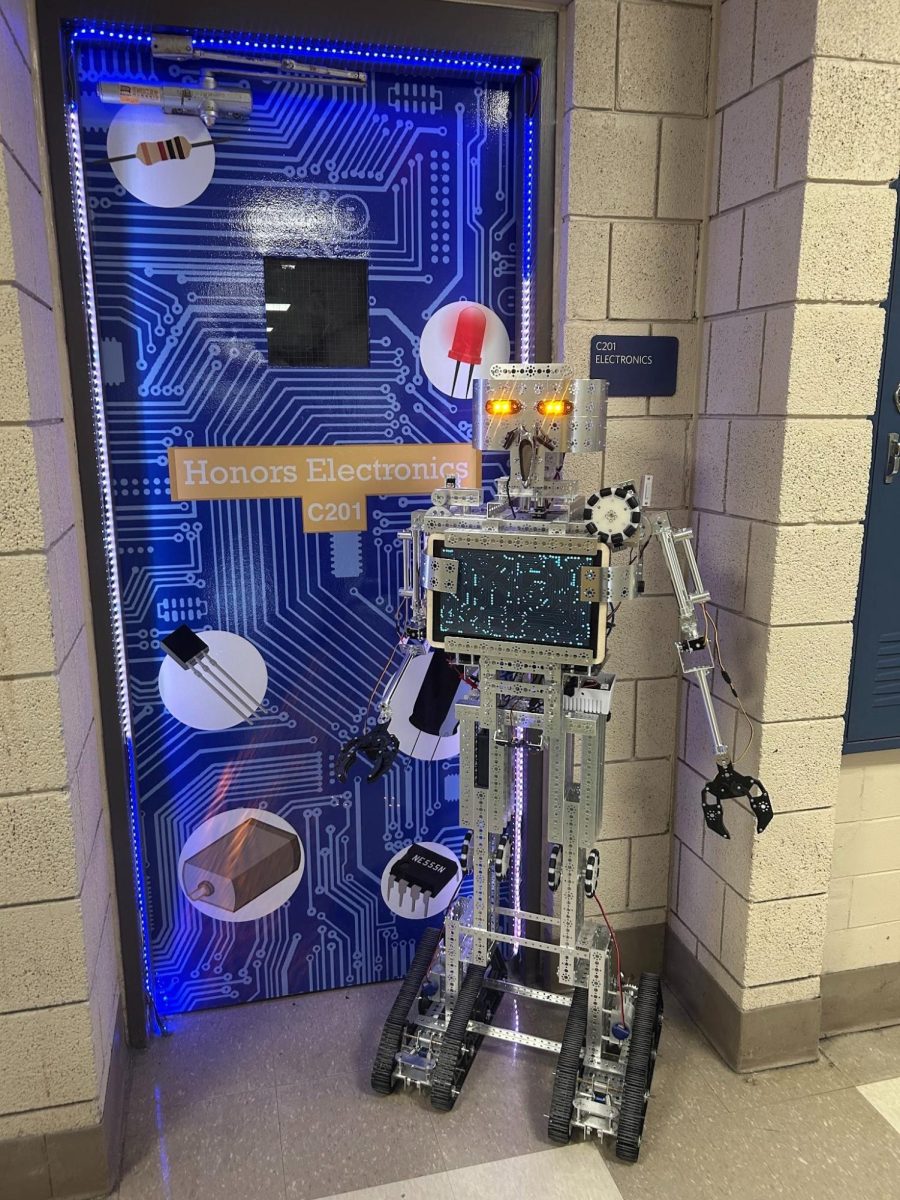
In the CTEi classrooms, a custom-built robot is making its way through the hallways, as now it can greet passersby with a synthesized “Good morning” or whatever phrase its operators type in.
This isn’t a high-end commercial bot, but it’s a student-driven project that’s been evolving over the past 3–4 years under the guidance of the Robotics Advisory teacher John Antonetti.
I asked Antonetti how the robot communicates, and he told me that it communicates in one direction: operators type commands or conversational phrases on a keyboard (or send pre-set ones), and the robot speaks to them aloud through its speaker.
“We can have robots say, ‘Good morning,’” Antonetti explained. “We can type it on a keyboard and send it out and have it say whatever we type out to it.”
They were able to customize the voice as well. Antonetti said that earlier versions sounded robotic and hard to understand. It was too fast and unclear. He said the team experimented with adjustments to make it more natural and audible.
They played with speed (speeding it up or slowing it down), tone, diction, and even accents to add “a little flair” and make the speech clearer and more comfortable to the ear. The voice defaults to a male tone in many setups, but the focus has been on clarity rather than strict gender selection.
Mobility comes from a simple but effective design: a tank-like tracked chassis powered by motors. “It runs on a tractor, like a tank kind of track,” Antonetti described. “It sits on like a 12-inch-long track of a motor with wheels.”
he tracks provide reliable movement without frequent maintenance checks, and operators can just move it around as needed, he said.
I asked him what is the current major upgrade that has been finalized on the bot, and he told me that the key upgrade has been networking. Repeaters in each classroom now give strong coverage throughout most of the building. And this allows remote control of the robot from various spots.
“We can sit from the desk and run it, Antonetti said, adding that the robot can move around alone in hallway when the control it from one room and a camera on the robot streams live video, so the operator can see where it’s going and even greet people in view while navigating.
Two-way audio isn’t fully there yet.
The robot can speak outward, but incoming responses aren’t picked up. That’s the next step. It is a continuous work in progress. The team checks for updates and options daily, adding features as technology evolves.
Looking ahead, Antonetti sees bigger things like more interactivity, possibly introducing AI for gestures and motion responses to commands
For now, there is only one robot in the building, but the door is open for students to suggest improvements or build on it.
“I am open to any suggestion students want to try and progress with it.”
This hands-on robotics effort shows how CTEi programs turn students into creators, blending programming, hardware, networking, and voice technology into something that literally moves through the school.