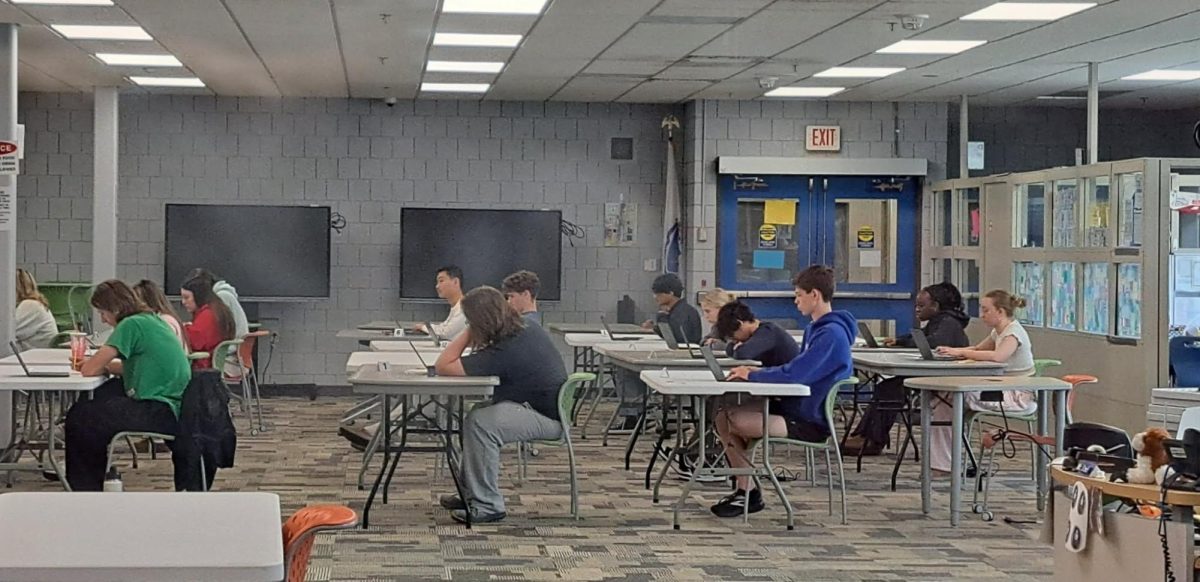
EDITORS NOTE: This is the first in an in-depth series focused on the state of education in the world and here at LHS. The Devil’s Advocate reporting team worked together to provide this deep analysis into the current trends concerning educators and students alike.
In today’s education system, technology has become a major part of students’ lives, but many people are beginning to question whether it is helping or hurting learning.
Articles from the Atlantic , NPR, Education Week, and the Guardian explain how students are facing problems caused by constant screen time, artificial intelligence, and social media.
Education Week states that many students are worried AI will “hurt their critical thinking skills, “ showing that even teenagers are concerned about becoming too dependent on technology.”
NPR wrote how social media platforms are designed to keep teens scrolling for long periods of time, which can lead to addiction and distractions in school.
Researchers mentioned in The Guardian also connected heavy social media use to “anxiety and depression” in children and teens.
These issues are seen in education today. In many classrooms, students are more focused on phones, laptops, or AI tools, than the lessons. The concerns prompted Massachusetts to vote to ban cell phones in school starting next year.
According to research, teachers are noticing shorter attention spans and less participation during class discussions because students often rely on technology to think for them. Because of this, some countries and schools are starting to make drastic changes.
Sweden, for example, is moving away from digital learning and bringing back paper textbooks and handwritten assignments. Supporters believe writing by hand helps students remember information better and stay more focused.
Other education groups are also calling for schools to reduce screen time to improve learning and mental health. Together, these articles tell the story of a generation trying to balance the benefits of technology with the growing problems it is creating in modern education.
Educators and parents are worried about recent reports showing that students have lower literacy rates, diminished critical thinking skills, a lack of concentration, and a lack of motivation.
There has been speculation about what the root cause of these issues may be. Reporting showed that some blame the switch from traditional pen-and-paper teaching to the new digital wave of chromebooks, smartphones, and social media. Covid 19 and the low expectations and lower standards it brought have been a point of contention.
To get to the root of the issue, we asked teachers and students what they felt was wrong with the current educational system, and what could be done to spur a change for the future.
One of the most common sentiments from students was that the school day is too redundant, with not enough engaging physical activity and too many repetitive assignments. Kids are not just unmotivated, but also bored, with most feeling like the only thing they have to look forward to at school is time with their friends.
When asked about what the most fun they’d had at Leominster High School was, Senior Hersh Patel had only one thing to say: “Friends”.
Lack of motivation and boredom can be seen in chronic absenteeism that plagues not only Leominster High, but across high schools nationwide.
According to Idrees Kahloon for the Atlantic , students are not showing up to school at all, “One in four students today is chronically absent, meaning that they miss more than a tenth of instructional days, a substantial increase from pre-pandemic averages.”
If students are not going to school, they cannot be gaining the benefits of their education.
Many experts also blame the decreased standards that were the result of the shutdowns during COVID-19.
There were many changes made in order to pursue the idea of No Child Left Behind. While the term also refers to the Act of 2001, many are using it to refer to the attitude during and following the COVID-19 shutdowns.
According to Tim Walker for NEA News, “Educators would no longer be able to use behavior, attendance, or tardiness as grading factors and they would be required to allow make-up work, regardless of the reason for the student’s absence.”
This drop in attendance that began with Covid 19, has not rebounded. We interviewed some LHS teachers about their thoughts on student attendance. AP Government teacher Larissa Murphy said, “For the first period (of the day), the biggest thing I notice is that nobody shows up on time. So many people are late, and that’s going to affect their ability to focus and learn if they’re trying to come in halfway through the class.”
LHS Science teacher Sherri Fairbanks said, “Anywhere from 5 to 6 students will arrive tardy to first period on a given day, which clearly interrupts focus since either I, or their classmates need to stop what we are doing and explain what we are working on.
According to The Atlantic and other publications, there is evidence that the decline in math and reading began before 2020, the age of COVID. So there’s another possible cause, the most widely agreed on: technology.
Technology has become a major tool in how students learn and function during school: phones, chromebooks, laptops, and even I-pads, are available to students. Due to COVID-19, there was a significant emphasis on the importance of every child having access to technology. It was needed: without it, learning could not continue at home.
But before that, research indicated that literacy and math skills declined when cell phones became common devices for students. That was years before Covid 19 required technology for distance learning.
Since returning to in-person classes, new rules at LHS have been set in place, such as the new cell phone ban, but does it actually help the students and the educational system?
According to the Ethics and Public Policy Center, student learning drops when the assignments are given to them online and they work better with paper. They reported, “the clearest consequence of screens and keyboards replacing pen and paper might be on kids’ ability to learn the building blocks of literacy—letters.”
Countries such as Sweden, Denmark, the Netherlands, France, China, and South Korea, have made a shift away from screens, and back to old-fashioned paper and pencil learning.
It is a shift back to basics that is slowly gaining ground in the US. Several teachers at LHS have reportedly said that they focus primarily on giving students paperwork, since students tend to cheat while working digitally.
Fairbanks said, “I am primarily paper-based. I use digital applications periodically when a hands-on alternative is not available, such as virtual autopsies.”
Not only has Fairbanks stated how she focuses on giving paperwork, but also math teacher Melony Letart and Murphy. Letart said she is “primarily paper-based.”
Murphy went into further detail, “Now paper-based. (I) tried moving everything online, but I just got AI back. Because of AI, I don’t let students do any assessments outside of class. Everything is handwritten, and it’s in class.”
Up next. we will take an honest look at the influence of AI on education.